Short answer
How does an address differ from a MEMO or Tag?
An address identifies the blockchain destination of a transfer. A MEMO, Tag, Destination Tag, or Payment ID is a separate identifier that some custodial services use to credit funds to a specific customer. If the Binance deposit page displays an address and an additional field, the sender needs both values. The network must also match on both sides. An account UID, order number, and payment comment do not replace a MEMO. [1] [2]
If the sender asks for a MEMO but the recipient form does not show one, or vice versa, stop. Do not substitute a UID, phone number, name, random zero, or old value from the history.
What exactly do the address, network, and MEMO do?
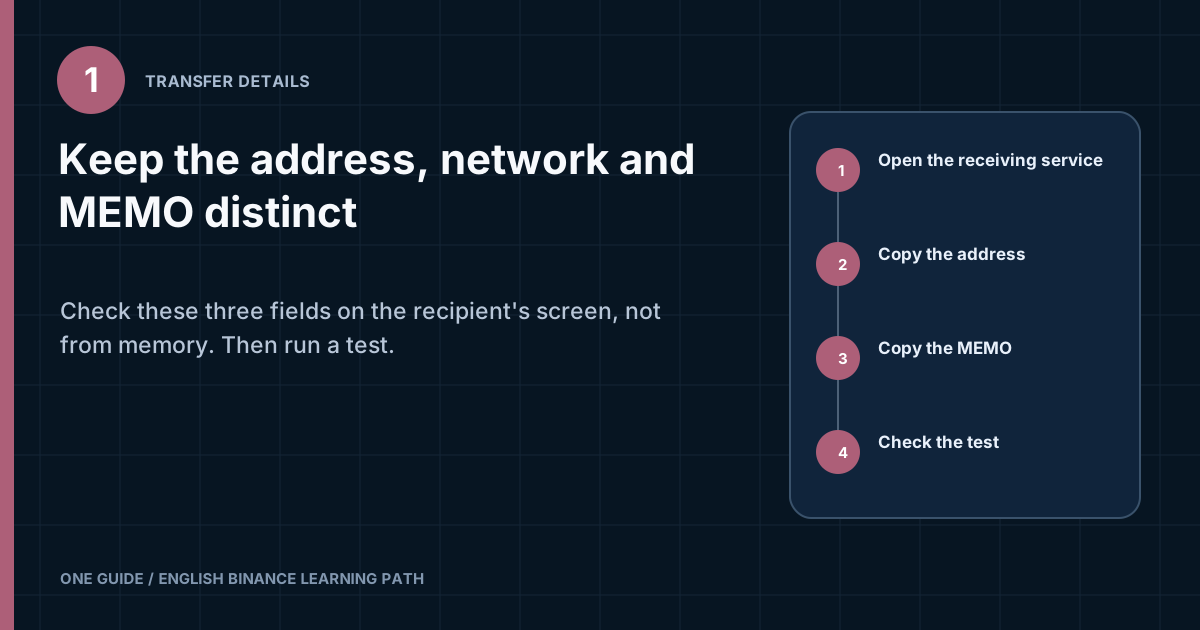
These three details answer different questions: where the transfer goes, which blockchain it uses, and who it is intended for inside the platform. An error in one field is not corrected by the other two being right. An address string may look valid but have been created for a different network. A MEMO may have a valid format but belong to another account.
| Detail | Function | Where to obtain it | Typical error |
|---|---|---|---|
| Network | Identifies the blockchain that will carry the asset | On the recipient's deposit page | Choose a cheaper network without checking support |
| Address | Identifies the destination within the selected network | Using the copy button next to the address | Take it from an old transaction or wallet history |
| MEMO/Tag | Helps the platform identify the internal recipient | From a separate field on the same page | Paste a UID or append a value to the address |
| TXID | Identifies a transaction that has already been published | In the sending history | Treating a TXID as a detail for a new transfer |
An address is not a private key. It can be given to a sender to receive funds. A seed phrase, private key, password, 2FA codes, and backup codes, however, must never be disclosed. Public technical data, not access secrets, is usually enough for support to locate a transaction.
Why can one address sometimes work on several similar networks?
An identical-looking string does not mean the same network. Some compatible blockchains use addresses with a similar format. A form may accept the string without an error because its syntax is valid, while the asset travels over a different route. This is why you check the network by its name and the recipient's data rather than the address's first characters.
When does Binance require a MEMO, Tag, or Payment ID?
An additional identifier is needed only when the current deposit page for the selected asset and network displays one. A platform may use a shared address for many customers. In that case, the MEMO helps the internal system determine which balance should receive the deposit.
The name depends on the asset and protocol. The interface may use MEMO, Tag, Destination Tag, or Payment ID. The meaning for the user is the same: it is a separate value copied without changes. You cannot infer the rule solely from the coin ticker because a personal wallet and a centralized platform may handle the same asset differently.
If Binance shows only an address after you select the asset and network, do not look for an additional number in a third-party article. Use the requirements shown on the specific recipient's screen at the time of the transaction.
Can you reuse an old MEMO?
A safe sequence means obtaining the details again for every new combination of sender, asset, and network. Even if the value matched before, the interface may have changed the route, suspended the network, or issued a new warning. A saved template is useful as a reference, but should not be the only source.
Where do you obtain the details for a transfer to Binance?
In your Binance account, open the crypto deposit section, select the asset and then the network, and only then copy the displayed values. Order matters: changing the network can change the address, MEMO requirement, minimum amount, and required number of confirmations.
- Start with the recipientOpen the deposit page for the required cryptocurrency in your Binance account. Do not obtain details from search results, correspondence, or someone else's video.
- Choose the assetCheck the full name and ticker. Similar names do not prove that it is the same token.
- Find the common networkIt must be supported by Binance for deposits and by the sender for withdrawals.
- Read the warningsCheck the minimum, network status, MEMO requirement, and special crediting conditions.
- Copy the fields separatelyFirst the address, then the MEMO or Tag if shown. Do not join the strings manually.
- Return to the senderSelect the same network, paste the details, and check the final screen again.
If the transfer goes from Binance to another platform, the logic is reversed: first open the deposit page at the external recipient. The recipient specifies the supported network and details. Then complete the Binance withdrawal form.
How do you copy a long address safely?
Copy the address with the built-in button, paste it once, and compare the resulting string with the source after pasting. Typing manually almost always creates unnecessary risk. Checking before pasting does not protect against malware that replaces clipboard contents.
- Source opened manuallyThe recipient's domain or app has been verified and was not opened through a random ad.
- Network already selectedThe address was obtained after selecting the network, not before.
- The string was not editedNo spaces, quotation marks, “address” label, or appended MEMO.
- More than the ends checkedMore than just the first and last two characters have been compared: distinctive fragments or the entire string.
- MEMO pasted separatelyThe additional value is in the field intended for it.
What is address poisoning?
Address poisoning is the fraudulent substitution of a familiar recipient with a similar string in the transaction history. An attacker creates an address with matching visible characters and sends a small or zero-value transaction, hoping the user will later copy the address from the history.
Do not use the latest incoming transaction as the source of an address. Open the recipient's details again. For recurring transfers, an address book and allowlist reduce the risk of accidental copying, but you must still match the saved entry with the recipient and network.
Which numbers are not a MEMO or Tag?
A UID, request number, TXID, confirmation code, and bank-payment comment serve different purposes and do not replace an additional blockchain-deposit identifier. A matching number of digits proves nothing. The correct value appears next to the address after the recipient selects the asset and network.
| Value | What it is used for | Can it be pasted as the MEMO? |
|---|---|---|
| UID Binance | Account identifier for certain platform features | No, unless the deposit form explicitly provided this value |
| TXID | Finding an already-sent transaction on the blockchain | No |
| 2FA code | Confirmation of an action by the account owner | No, the code remains secret |
| Order number | Finding a trading or payment transaction | No |
| MEMO from the deposit screen | Linking the deposit to the internal recipient | Yes, in a separate field |
If the sending platform calls the field “Comment,” read the prompt next to it. Sometimes it is an ordinary personal note that is not transmitted on the blockchain. Sometimes the interface uses a localized name for a MEMO. The meaning must be confirmed by the documentation and recipient's screen, not guessed from the label.
How do you verify the details on a second device?
Open the recipient page on a trusted device and compare the network, address, and additional field independently of the first device's clipboard. For an address, it helps to split the string into several fragments and read them in order. Do not send details through a public chat where the message can be replaced or copied.
A second check is especially useful after installing a new app, when withdrawing a substantial amount, and after an antivirus warning. It does not require logging into the account on someone else's computer. Using your own up-to-date phone and computer is safer than asking an acquaintance to log in with your credentials.
Do a QR code and address book make a transfer safe?
They reduce the risk of a typo, but do not verify the asset, network, or meaning of the details. A QR code transmits an encoded string. If the wrong screen was selected, the code will accurately transfer the wrong data. After scanning, compare the displayed address and network before confirming.
An address book is useful for recurring recipients. The label should explain who the entry is for and which network it uses. A name such as “my wallet” is too vague. If the platform imposes a lock period after a new address is added, treat it as protection rather than a reason to bypass the restriction.
When is a test transfer needed?
A test is especially useful for a new address, new network, large main amount, or mandatory MEMO. Its purpose is not to check the asset's price, but to prove that the selected combination of details leads to the recipient's expected balance.
- Check the recipient's minimum deposit and the sender's minimum withdrawal.
- Account for the fee so that the amount after deduction remains above the deposit minimum.
- Send a limited amount whose loss would not create a critical situation.
- Wait for actual credit to the correct balance, not only a status in the explorer.
- For the main amount, reopen the details and repeat the check. Do not rely on autofill without reviewing it.
A test does not eliminate the network fee and may be uneconomical for a very small total amount. The decision depends on the current minimums and fee shown on the screen. A high fee, however, does not justify sending without verification if an error would cause a much larger loss.
What does a TXID show, and what does it not prove?
A TXID, or transaction hash, lets you find a public transaction in the relevant blockchain explorer. It is used to check the network, status, addresses, amount, and confirmations. On Binance, a withdrawal TXID is usually available in transaction history after the transaction is submitted to the blockchain.
A TXID is not a receipt proving final credit to a platform's internal balance. An explorer may show a confirmed transaction to an address, but without the correct MEMO the service still does not know the internal recipient. Conversely, if no TXID has been created yet, the transaction may still be undergoing the sender's internal processing.
| What you see | What this usually means | Next check |
|---|---|---|
| No TXID | The sender has not published the transaction yet | Withdrawal history and status on the sender's side |
| Pending | The transaction is waiting for activation or confirmations | Network status and number of confirmations |
| Success, but the balance is empty | The blockchain accepted the transaction, but crediting is not complete | Address, network, MEMO, minimum, and deposit history |
| Different address | Funds went to a destination other than the one expected | Do not repeat the transfer; collect data for support |
What should you do if the MEMO was omitted or entered incorrectly?
Do not send a second transfer “for activation” or pay someone in a chat for recovery. Save the TXID, network, address, amount, asset, time, and a screenshot of your own records. Then open the deposit history and official support center of the receiving platform.
If the withdrawal form itself did not accept the MEMO or address and no request was created, there is no TXID yet. This is a different situation, covered in the troubleshooting guide for withdrawals that are not working.
With the correct address, funds may be at the service's shared address but not automatically matched to the account. Recovery depends on the asset, network, sufficient confirmations, and internal procedures. The platform may request additional evidence or refuse. A TXID helps the investigation, but does not guarantee the outcome or give anyone a right to funds associated with someone else's MEMO.
What must you never disclose to a “recovery specialist”?
A seed phrase, private key, password, or 2FA code is not needed to locate a transfer. Anyone who asks for this data is trying to gain control of the assets. Open support through the official website or app, not through a private message sent after you publish a problem.
Can you publish an address and TXID?
An address and TXID are public technical data, but publishing them may expose a balance and transaction history. On a blockchain, pseudonymity is not the same as complete anonymity. By linking an address to a social-media account, a person helps observers associate transactions with an identity.
When contacting support, submit only necessary information through an official channel. On a public forum, it is better to conceal unnecessary parts if the full address is not needed for diagnosis. Never publish access secrets. If the situation involves a legal dispute or a substantial amount, preserve the original data separately and consider professional advice.
Frequently asked questions
Are MEMO and Tag the same thing?
For the practical purpose of completing a form, these are types of additional identifier. The asset or receiving platform determines the name and format. Copy exactly the value shown by the recipient.
Can you paste the MEMO into the address field?
No. The address and MEMO go into separate fields. A combined string may be rejected or route the transaction incorrectly.
Can you omit the MEMO if the field is optional?
An “optional” label on the sender's side does not override the recipient's requirement. Make the decision based on the recipient's deposit page. If it requires a Tag, copy it.
Is it enough to compare the first and last characters?
This is better than no comparison, but attacks using similar ends make a short check insufficient. For a substantial amount, compare the entire string or more fragments and perform a test.
Can you cancel a confirmed transfer?
An ordinary blockchain transaction has no cancel button after confirmation. Whether it can be returned depends on control of the recipient address and the recipient's consent or the custodial platform's procedures.
Official sources to check
Sources checked on August 8, 2026. Always obtain the current details and network availability from your own account.